
With fire doors under increasing scrutiny, Emplas is applying the same data-driven, process-led approach used across its factory to one of the industry’s most safety-critical products. We report.
Emplas’ launch of its fully accredited 30-minute Fire Doorset is doing more than opening new opportunities in specification and refurbishment markets. It is reshaping how the business approaches design, manufacture and control across its operation.
Tested to BS EN 1634-1, EN 1634-3 and PAS 24:2022, and independently assessed by Warrington Fire as part of BM Trada Q-Mark certification, the doorset achieved up to 58 minutes fire integrity with no failings recorded, exceeding the 30-minute requirement.
Delivered in partnership with Winkhaus and DoorCo, the new Fire Stop Doors range opens up significant opportunities in specification and social refurbishment markets. Manufactured by Emplas, the doorset combines the DoorCo 30-minute Firecore slab, Winkhaus FireFrame door profile and Winkhaus AV2 autolocking system, delivered as a fully systemised solution.
For Emplas, that system approach is critical. Fire doors are not treated as standalone products, but as integrated assemblies where every component and process must align with a defined field of application and third-party approval.
“There’s no flexibility to substitute components or deviate from the specification,” explains Bruce Rowell, Head of SHEQ and Technical, Emplas. “Everything has to be tested, audited and signed off as part of the system.”
System-led manufacturing
That philosophy is driving change on the shop floor. To support the fire doors, Emplas has introduced controls designed to eliminate risk at source.
A key focus is on intumescent materials, which are essential to fire and smoke performance. If incorrectly fitted or omitted, the door will fail regardless of test data.
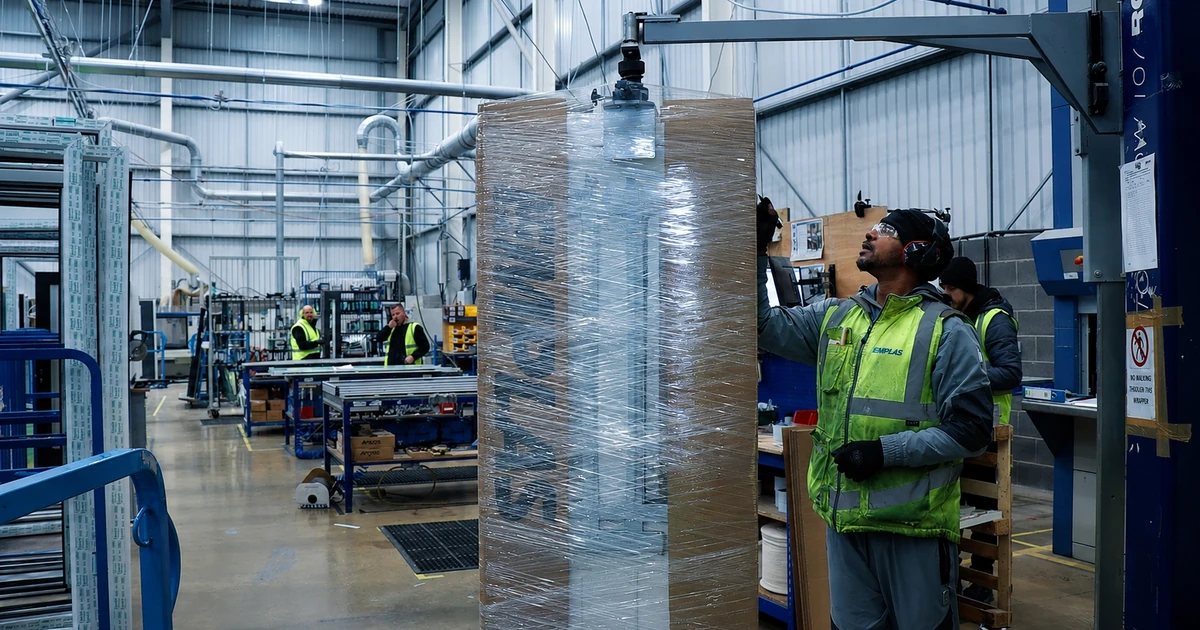
To mitigate this, Emplas has introduced camera-based verification systems that confirm the presence and positioning of key components during manufacture. If a check fails, the product cannot move forward or be booked for dispatch.
The company has also invested in a dedicated fire door production line, recognising the additional weight and complexity of fire-rated products.
Golden thread compliance
Emplas has aligned its Fire Stop Doors range with the Building Safety Act and the industry’s “Golden Thread” of information.
Each door is fully traceable, including component batch data, manufacturing processes and quality checks, supported by digital auditing.
“We’ve developed a digital auditing system which supports compliance right the way through from manufacture to installation and maintenance,” continues Bruce.
“That supports us, our customers and ultimately housing providers and developers to evidence compliance, meeting the requirements set out in the Building Safety Act, and critically, the ‘Golden Thread’.”
Closing the loop on installation
Emplas is clear that manufacturing quality alone is not enough. Installation must align with the tested system if performance is to be maintained.
Every fire door is supplied with independently tested installation and maintenance manuals, alongside digital guidance accessed via QR code.
The company has also invested in BM Trada fire door survey, installation and maintenance training, ensuring its teams understand site requirements.
“Under law, there is no legal requirement to be trained to install fire doors,” Bruce adds. “However, if it goes wrong, you have to be able to prove competence.”
From compliance to confidence
By combining system-led design, third-party certification, process control and installation support, Emplas is moving beyond compliance.
With around 5 million fire doors installed across the UK and more than 80,000 replaced each year, the opportunity is significant, but one that demands control, transparency and accountability at every stage.