
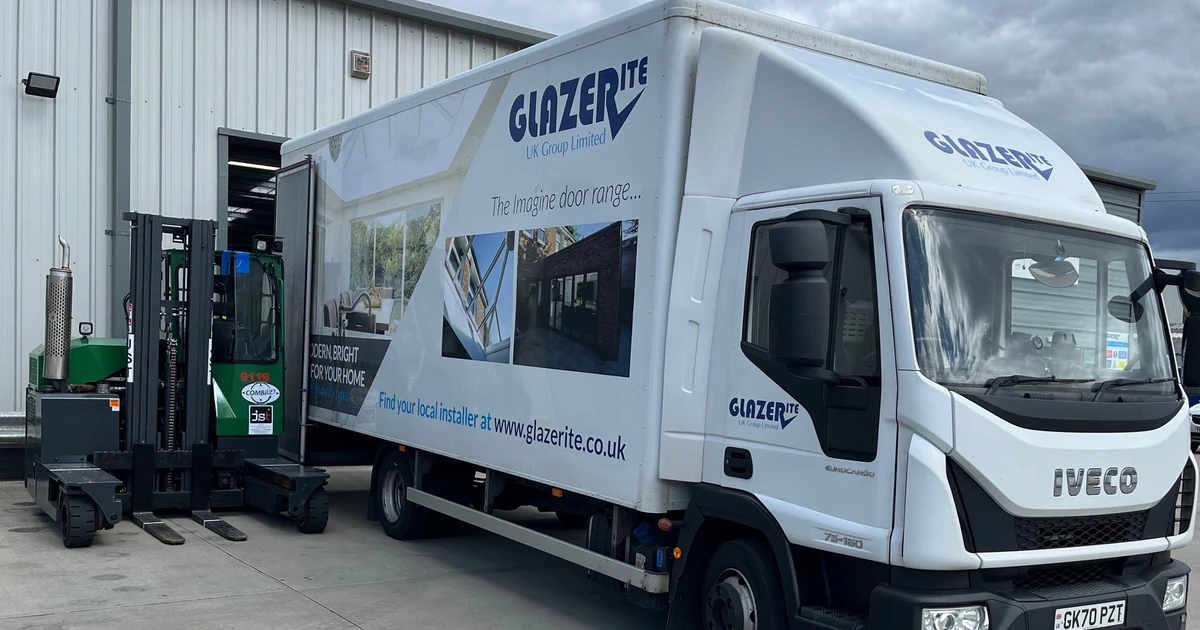
Getting windows and doors to customers safely and on time requires careful planning, particularly when product requirements, delivery locations and order sizes can vary significantly from one customer to the next.
At Glazerite, delivery planning takes those different requirements into account, with vehicle choice and routes organised around the customers being served.
For Darren Rhodes, Managing Director North, understanding the requirements of each delivery is an important part of maintaining a reliable service across the UK.
"We look at the types of vehicles we're running and what works best for particular customers and routes," Darren says.
"That could mean using smaller or larger vehicles depending on where we're going, what we're carrying and what the customer needs."
Across its fleet, Glazerite generally uses 18-tonne vehicles where suitable, giving the business the capacity to combine several customer deliveries into one journey.
Multi-drop routes can see a single vehicle visit five, six, seven or even eight customers, allowing Glazerite to plan deliveries across different locations as part of the same run.
This approach is particularly important for customers based further away from Glazerite's manufacturing sites.
Scotland provides a good example.
Glazerite can make at least three journeys into different parts of Scotland each week, with each route planned around the location of customers and the products being delivered.
"We'll generally run 18-tonne vehicles so we can do multi-drop deliveries," Darren explains.
"We can send one vehicle into Scotland and it might do five, six, seven or even eight drops to different customers.
"Sometimes we'll do at least three runs a week into different parts of Scotland because of the number of customers and the areas we need to cover."
Planning those deliveries also requires an understanding of the particular product requirements of the Scottish market.
Glazerite's Scottish customers typically require glazed products, which adds significant weight to each window being transported.
The additional weight has an impact on how much product can be carried on each vehicle and therefore needs to be considered when deciding which vehicle is used and how a route is planned.
"Our Scottish market is very different in terms of the products we're delivering," Darren says.
"The Scottish market requires glazed product, which is obviously much heavier, and that has an impact on the size of vehicle we can use and how we plan the delivery."
The weight of glazed products also influences how windows and doors are prepared before they leave the factory.
Additional protection is used during transportation, while products are labelled differently to help customers with manual handling when they arrive.
This means the delivery process starts well before a vehicle leaves the Glazerite site.
Teams need to consider the products being manufactured, their weight, how they will be protected during transportation and how they can be handled safely at the other end.
"Packaging windows and doors for the Scottish market is quite different because everything is glazed," Darren explains.
"It's much heavier, so we have to put more protection on the products and label them differently because of the weight and the manual handling requirements for our customers."
Alongside customer and product requirements, Glazerite also monitors the performance of its fleet across every site.
Over the last five years, the business has operated a fleet replacement programme, updating vehicles as part of its approach to managing delivery performance.
Fuel consumption is monitored by vehicle and driver, giving the business information that can help with future fleet and route planning.
Glazerite has found that driving style alone can create a difference of between 10% and 15% in fuel consumption per driver.
"Driving style makes quite a big difference to fuel consumption, which is why we monitor it and have set targets," Darren says.
"That information also leads us to look at the types of vehicles we're running into certain customers and whether a smaller or larger vehicle is the best option."
Bringing this information together allows Glazerite to make decisions based on the requirements of individual routes.
Vehicle size, customer location, product weight and the number of drops all play a part in how deliveries are organised.
For installers, careful planning helps provide the regular and reliable deliveries they need to manage their own workloads.
It is particularly valuable when servicing areas such as Scotland, where distance and product requirements add further considerations to every journey.
Glazerite's approach is built around understanding those requirements and planning its fleet accordingly, whether that involves choosing the right vehicle, combining several deliveries into a multi-drop route or adapting packaging to suit the products being transported.
"Every customer and every route can have different requirements, so we have to take that into account when we're planning deliveries.” Darren concludes.
"It's about using the right vehicles, planning the routes properly and making sure the products reach our customers safely and in the way they need them."