By Wayne Hunter, Operations Manager, Emmegi (UK)
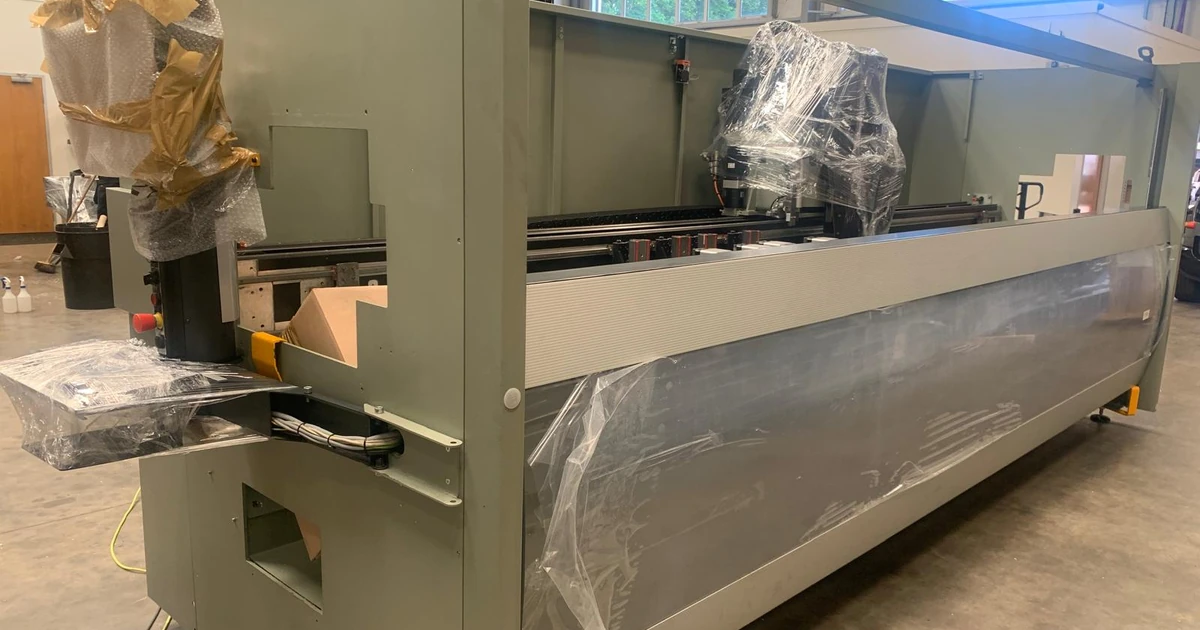
Emmegi (UK) has supplied no fewer than 10 refurbished CNC, saws and pieces of industrial equipment over the past year and a half including a Phantomatic X4, a T3A and a Classic Star – an average of more than one every two months. That’s a significant increase on previous years and certainly reflects the tough market conditions - and the fact that fabricators are looking for the very best value from any investment.
Of course, it's also testament to the standard of our machine refurbishment programme and the quality of the work carried out by our engineering team. But more than that, I think it reflects both a growing awareness of the environmental savings that can come from choosing refurbished over new, and the benefits that being able to demonstrate those savings can have - particularly for fabricators operating in the commercial sector.
With such a focus now on ESG assessments and EPDs in our industry, Emmegi’s parent company Voilàp Holding does a huge amount of work to provide supporting evidence on the environmental efficiency of our machine ranges as part of its overall commitment to sustainability.
For instance, in 2025, the company introduced an energy consumption matrix using MID (Measuring Instruments Directive) certified, ISO 14955 compliant tests to show the Watt hours per piece (Wh/piece). Stand out figures include the Satellite XLE at 99.6 Wh/piece, the Satellite XTE at 166.3 Wh/piece, and the +Quadra L2 at 169.7 Wh/piece. These figures are up to 71.8% less than the highest average across other similar machines which are 353.03 Wh/piece.
Last year Voilàp also obtained its first ISO14067 certification for the Product Carbon Footprint (PCF) of the Emmegi Satellite XTE and Emmegi Satellite SLE CNCs. Using standardised Life Cycle Assessment (LCA) methodology, this certification provides full transparency on the greenhouse gas emissions generated throughout the machines’ entire product life cycle – from raw material to disposal.
In turn, this has also allowed Emmegi to make corresponding calculations on the emission savings available from refurbishing a machine rather than building a new one. And, when you take into account the emissions avoided, the energy reduction and the improved material circularity that comes from reducing waste, the figure for the net reduction in CO2, is around 90%.
One of the things being calculated is the weight of components salvaged, reused or recertified. Here in the UK, we are required to measure and report our own savings and report these back to Voilàp so that they can form part of the company’s sustainability report which sets out the company’s ESG roadmap and tracks our progress. The 10 machines we have refurbished since the start of 2025 added up to an impressive 12,300kg and we have a further six machines currently undergoing refurbishment which will be added to that total this year.
I’m obviously not advocating used over new every time, but I am convinced of the environmental benefits of refurbishment, and I would certainly invite fabricators who are disposing of their machines to contact us first so that we can assess the value and viability of giving that machine a useful second life.
Alongside encouraging refurbishment of machines and components, Voilàp has a vast programme of projects underway to facilitate our transition to net zero - all with defined targets. These include the successful move to 100% renewable energy in all the European production plants, adoption of eco-design requirements in product development and a switch to sustainable and circular materials in manufacture and packaging.
For more information visit emmegi.com